
[+] More Specifications
[-] More Specifications
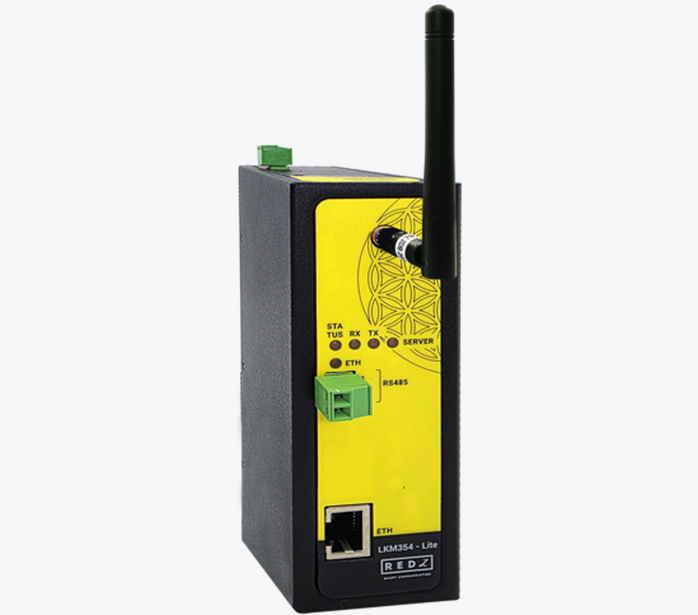
- 1 x 10/100 Ethernet port
- 1 x RS485 port; no RS232 for the meters and for the Modbus RTU output
- Embedded web interface
- Reads electricity meters with IEC 62056-21 (Mode C), DLMS/COSEM, and DLMS/COSEM with IEC 62056-21 opening
- Meter side start baud rate selectable from 300 to 115200 baud for each meter
- 2 device functions:
• Serial Electricity Meter to Modbus TCP Gateway (and MQTT Publisher): meters on the RS485 port, data given out as Modbus TCP (and MQTT)
• TCP/IP Electricity Meter to Modbus RTU Gateway (and MQTT Publisher): meters on the network (IP address and TCP port of each meter), data given out as Modbus RTU on the RS485 port (and MQTT)
- Up to 10 meters (IEC 62056-21 and DLMS/COSEM), data converted to Modbus TCP or Modbus RTU
- Up to 48 OBIS codes per meter profile, 6 profiles (IEC 62056-21, Landis+Gyr DLMS, Actaris/Itron, Iskra DLMS, Cewe DLMS, Generic DLMS), all set from the web interface
- Several IEC meters on one RS485 line: a read-out that comes from another meter than the one asked is not stored
- Negative meter values keep their sign; a value too large for the 32-bit register gives a fixed limit value
- Modbus TCP server with up to 10 clients at the same time, or Modbus RTU output from 300 to 460800 baud
- Function code 03 (Read Holding Registers); every value is 32 bits = 2 registers, 48 values per meter row
- MQTT publisher with two data formats (OBIS VALUES AS OBJECTS and OBIS VALUES AS MODBUS FRAME), at the same time as Modbus
- 868 MHz LoRaWAN Meter Reader: the meter data is also sent to a LoRaWAN network server through a LoRaWAN gateway
- Radio band EU 868 MHz (Europe); the send interval is set by the user
- Built-in duty cycle check and payload size check: the device splits the data by the maximum payload size and the duty cycle block times, so the meters can be read at any interval
- Activation over the air (OTAA) or by personalization (ABP); Class A or Class C
- Adaptive Data Rate, selectable uplink data rate and Tx power level (EIRP), user defined LoRaWAN port, with or without ACK
- Device and LoRaWAN status on the LoRa Status page, including the latest LoRaWAN messages
- Meter reading, Modbus communication and OBIS-to-Modbus mapping status, and the meter read-out data, on the web interface
- Device Status overview cards for the meters, Modbus, MQTT and LoRaWAN, each with a green, amber, red or grey dot
- White list or black list IP filter with up to 20 IP addresses (in the Modbus TCP function)
- DHCP server
- Firmware update over the web interface; 2 firmware banks in the device (1 active), the previous firmware can be started again
- Configuration backup and restore as a file
- No console connection for logs; the log goes to a UDP server
- 9 - 36 V DC power input (40 V maximum)
- Operating temperature -40 to 85 C
- Rugged metal IP-40 housing
- DIN-rail mounting